10 — Combine Ability Model (latent IRT, de-biked)
10 — Combine Ability Model (latent IRT, de-biked)
Goal. Estimate a latent per-player combine ability (theta) that is robust
to small n and to "biking" (late multiple-choice guessing that is +EV under
the combine's −1-only-on-wrong-MC penalty). Produce both a raw combine number and
a de-biked ability estimate, with standard errors / shrinkage, per overall and per
category.
- Script:
scripts/combine_ability.py - Output:
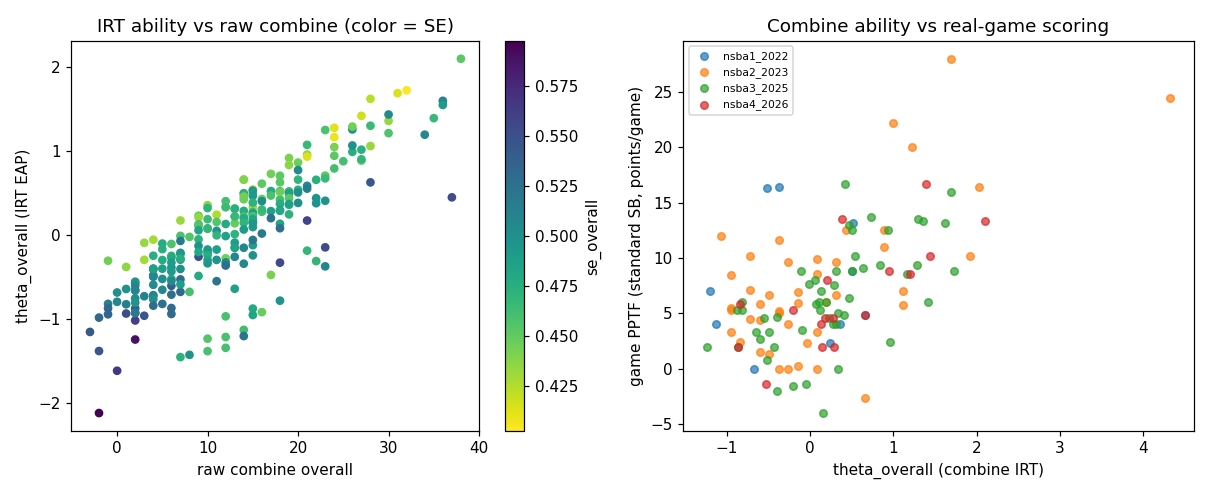
data/processed/combine_ability.csv(255 rows; one per player×season) - Plot:
outputs/combine_ability.png - Env:
/home/david/code/nsba/.venv/bin/python· model:girth.grm_mml_eap(GRM)
Two scoring worlds, never mixed. The combine is pyramidal & gameable (points {0,2,3,4}, −1 penalty; earlier buzz scores more). Games are standard Science Bowl (+4/−4/+10, not pyramidal). The IRT model is fit only on combine data; game scoring (PPTF) is used only for out-of-sample validation.
Method
1. Ordinal outcome per question (pyramidal + biking tier)
Each combine question (per-question seasons nsba1/3/4 only) is recoded to an ordered category that encodes both buzz-earliness and the biking signal:
| ord | meaning | source |
|---|---|---|
| 0 | wrong MC guess (the biking tier, worst) | penalty=−1, no points |
| 1 | skipped / unattempted | points NaN, no penalty |
| 2 | attempted, no credit | points = 0 |
| 3 | correct, latest tier | points = 2 |
| 4 | power | points = 3 |
| 5 | superpower (earliest) | points = 4 |
2. Graded Response Model (GRM)
Items = category × question_num (24 items; 20 for nsba1's 5-category Energy era).
girth.grm_mml_eap (mixed Bayesian / marginal-MML — built for small samples) gives
per-item discrimination + ordered thresholds. Player abilities are the EAP
(posterior mean over a N(0,1) prior, custom quadrature) with a posterior-SD
standard error — this is where the shrinkage / small-n robustness comes from.
theta_overall is fit on all items; each theta_{cat} is fit on that category's
items only. Single-level (no-information) items are dropped from the item fit.
3. Aggregate-only season (nsba2_2023)
nsba2 has no per-question data — only category totals + an Overall sheet. So
theta_overall is the within-season z-score of the recorded Overall (CS included),
and theta_{cat} are z-scored category totals. Reduced resolution: a nominal
wide SE (0.8) flags that these are aggregate, not item-level, estimates.
4. De-biking (debiked_overall)
Biking = late WXYZ guessing, +EV because only a wrong MC costs −1 while short-answer buzzes are unpenalized; CS is "unbikable" (cleaner signal). The de-biked GRM is re-fit with the gameable cheap-credit neutralised: - the wrong-MC tier (ord 0) is treated as MISSING, not informative; and - CS items are up-weighted (duplicated) in the overall fit so the unbikable category carries more of the signal.
Honest limitation: the data does not record question type (short-answer
vs MC), so we cannot cleanly separate a wrong-MC guess from a wrong short-answer
buzz. debiked_overall is therefore a directional adjustment, not a clean
correction — treat it as "ability with the most-gameable signal down-weighted."
Identity
Joined to canonical_players.csv (source='combine') on (season, player_raw),
with discord_tag used to split nsba2's 4 shared-name pairs. 251/255 rows
matched. The 4 unmatched are the second member of each nsba2 shared-name pair
(Owen/Aditya/Rishabh/Rohan) — they have no separately-reconciled canonical row, so
per the identity guardrail they are kept raw, not force-matched (canonical_id
left blank). Their per-category thetas are also blank because the category table
carries no discord_tag to disambiguate them.
Results
Validation A — does theta track raw combine? (in-sample)
Pearson corr(theta_overall, raw_overall):
| season | corr | n | note |
|---|---|---|---|
| nsba3_2025 | 0.967 | 91 | full per-question, 6 cats |
| nsba4_2026 | 0.964 | 52 | full per-question, draft target |
| nsba2_2023 | 1.000 | 51 | trivial — theta is z(raw) here (aggregate) |
| nsba1_2022 | 0.555 | 61 | 5-cat Energy era, heavily biked (see below) |
theta closely tracks raw where the per-question signal is rich (nsba3/4). The low nsba1 correlation is a feature, not a bug (next section).
Validation B — does theta predict REAL game scoring? (out-of-sample)
123 players link combine→clean games (≥2 games). Corr with standard-SB game PPTF (points per game):
| metric | pooled | nsba1 (n=10) | nsba2 (n=44) | nsba3 (n=52) | nsba4 (n=17) |
|---|---|---|---|---|---|
theta_overall |
0.575 | 0.037 | 0.635 | 0.612 | 0.732 |
debiked_overall |
0.541 | 0.415 | 0.635 | 0.473 | 0.655 |
raw_overall |
0.605 | 0.306 | 0.635 | 0.648 | 0.750 |
Combine ability is a moderate predictor of real-game scoring (r ≈ 0.6 in the data-rich seasons) — consistent with the prior that the combine is a noisy, gameable seed, not ground truth.
The de-biking payoff is concentrated where biking happens
On nsba1 — the most-biked, Energy-era season — de-biking flips the ranking
toward real ability: debiked (0.415) > raw (0.306) > plain theta (0.037)
against game PPTF. Concrete cases (nsba1):
- "Ne Dassanayake": raw = 37 (top score) but attempted only 12/20 questions →
cheap late accumulation. GRM theta = +0.45 (modest), not elite.
- "nihal" / "Avaneesh": attempted all 20 (engaged with hard items), low raw
(−1, 1) but theta ≈ −0.3 — less punished than raw, because attempting hard
items is informative.
So de-biking earns its keep exactly where the prior (D7) says it should. In the
clean per-question seasons (nsba3/4) plain theta and raw are already close and
de-biking slightly hurts PPTF correlation — expected, since there is less biking
to remove there and down-weighting real cheap-but-correct answers loses signal.
Output schema (data/processed/combine_ability.csv)
canonical_id, season, player_raw, theta_overall, se_overall,
theta_{bio,chem,cs,ess,math,phys}, debiked_overall, raw_overall
- theta/debiked are on a ~N(0,1) latent scale (shrunk; std ≈ 0.69 within
per-question seasons due to EAP shrinkage). raw_overall is the recorded combine
number (different units per season — do not pool raw across seasons).
- se_overall range 0.40–0.55 (per-question) / 0.80 (nsba2 aggregate).
- theta_cs is blank for all nsba1 (no CS in the Energy era) and for nsba2's 4
unassignable shared-name rows.
Limitations / caveats
- De-biking is partial. Without question type (MC vs short-answer) we cannot
isolate true biking;
debiked_overalldown-weights the most-gameable signal but is directional, not exact. Trust it most on nsba1 (where biking is rampant); on nsba3/4 it adds little. - Small n per player. 24 items max (20 for nsba1), fewer attempted. EAP shrinkage is the right tool but means extreme players are pulled toward 0; read theta with its SE.
- nsba2 is aggregate-only —
thetathere is just a z-scored Overall (no item resolution, wide SE). Its per-category thetas come from category totals. - Cross-season scale. thetas are standardized within season; they are comparable in rank within a season but not an absolute cross-season scale. Game-PPTF validation suggests the seasons are roughly commensurable, but don't over-read small cross-season theta gaps.
- Validation n is small, especially nsba1 (10 linked players) and nsba4 (17, cross-season since nsba4 has no games). Treat per-season PPTF correlations as directional.
- Trust games over combine (prior D7): where a player has real game data, that is the stronger signal; this model is for the nsba4 draft pool where combine is often all we have.
Reproduce
/home/david/code/nsba/.venv/bin/python scripts/combine_ability.py
Writes data/processed/combine_ability.csv and outputs/combine_ability.png;
prints the validation tables above.