17 — CS Scarcity & Draft Value (falsify-first)
17 — CS Scarcity & Draft Value (falsify-first)
Question: Should the NSBA4 draft reach for a Computer-Science specialist? CS is NSBA-only, appears in games only in nsba2 (2023) and nsba3 (2025), and the draft target (nsba4) has no games yet — so all in-game evidence comes from those two seasons.
Data / method. Game data only (standard SB scoring), clean-game filter
(reconciles==True & not-both-zero) → 180 clean games, of which 114 are
nsba2/nsba3 (the CS seasons). Buzz rows joined to canonical_players
(source='game'), 0 join loss. Player CS profile = correct/total CS buzzes per
player-season; "rotation players" = player-seasons with ≥5 total correct
toss-ups (n=95). Team analysis on team_season.csv (29 nsba2/3 team-seasons),
with point-share × points/game decomposed into CS vs non-CS offense. All
regressions WLS, weighted by games played (small n — every number below is
two seasons of data; treat as directional).
1. The falsifier FAILS — generalists do NOT already cover CS
Prior worry: maybe strong generalists convert CS anyway, making a CS specialist redundant. Tested directly on every player who attempted (buzzed) at least one CS toss-up:
| group | players | CS buzzes | CS correct | pooled CS conversion |
|---|---|---|---|---|
| CS-mains (CS is their top-scoring subject) | 8 | 129 | 80 | 0.620 |
| generalists (non-CS-main) | 59 | 385 | 187 | 0.486 |
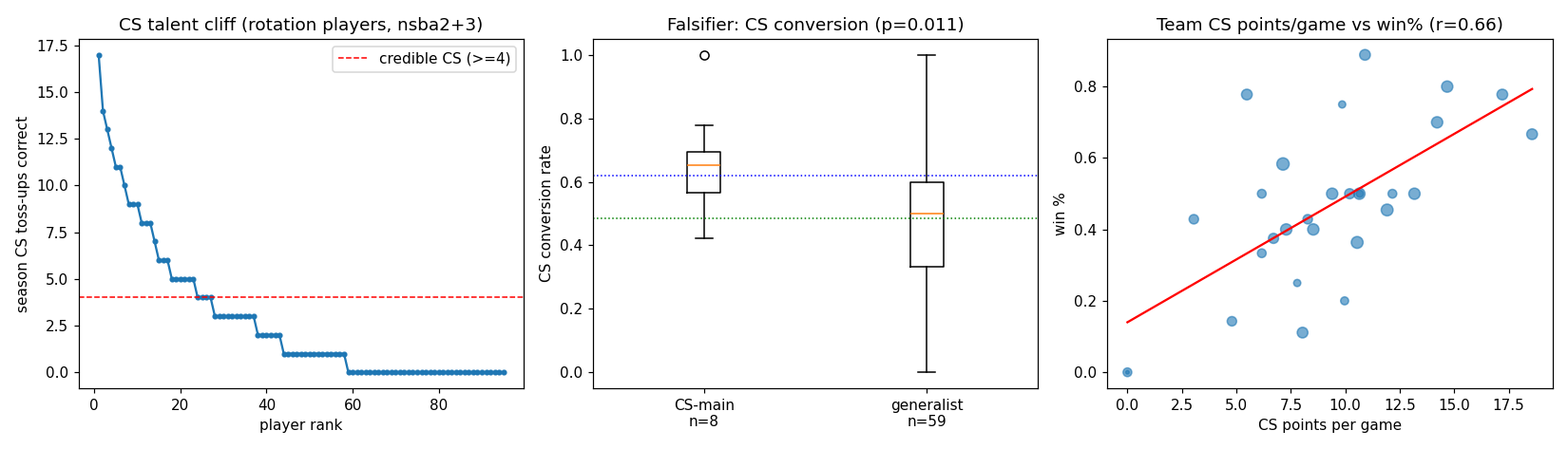
χ² = 6.47, p = 0.011. CS-mains convert CS ~13 points higher than generalists do. Generalists buzzing CS miss it more than half the time. So a generalist roster does not get CS "for free" — the falsifier is rejected.
(Caveat: by volume generalists still produce 70% of CS points (187 of 267), because there are ~7× more of them. The issue is per-buzz reliability, not raw volume.)
2. CS ability is scarce, and the cliff is steep
Among the 95 rotation players (two full seasons): - only 8 (8.4%) have CS as their main subject; - only 27 (28.4%) are "credible" CS answerers (≥4 CS correct on the season); - median CS correct = 1; 39% of rotation players never convert a single CS toss-up.
Talent cliff (season CS toss-ups correct by rank): 17, 14, 13, … 11 (#5) … 9 (#10) … 5 (#20) … 1 (#50). The drop from an elite CS answerer to replacement level is brutal — roughly one credible CS body per team, and many teams have none.
CS is also the hardest category to answer at all: question-level conversion (any player gets it) is 69.9% for CS, the lowest of all six subjects (b 84%, ess 80%, m 80%, p 78%, ch 72%, cs 70%). CS toss-ups go dead more often, so owning CS = points opponents structurally cannot take.
The combine CS signal is real and identifiable. Combine theta_cs predicts
in-game CS correct at r = 0.60 (n=84), clearly better than theta_overall
(r = 0.39). Consistent with the D7 prior that CS is "unbikable" / a cleaner
combine signal than the gameable categories — so you can trust the combine to
find a CS specialist before the draft, unlike most categories.
3. CS points are worth far more wins than other points
Team win% regressed on points/game, split by category (WLS, weighted by games, controlling for rest-of-offense):
| subject | marginal win% per (pt/game) | t | mean pts/game |
|---|---|---|---|
| cs | 0.0282 | 4.55 | 9.1 |
| ess | 0.0118 | 2.44 | 12.1 |
| m | 0.0109 | 2.08 | 14.8 |
| b | 0.0044 | 0.77 | 13.4 |
| ch | 0.0041 | 0.78 | 11.7 |
| p | 0.0031 | 0.52 | 11.9 |
A CS point is worth ~2.4–9× a point in any other category for winning, and CS is the only category whose marginal win value is large and highly significant. In the head-to-head decomposition (CS pts/game vs all non-CS pts/game): CS coef 0.0282 ± 0.0062 (t=4.55) vs non-CS 0.0081 ± 0.0017 (t=4.69) — CS points are ~3.5× as valuable as generic points. The CS coefficient is robust to jackknife (range 0.0245–0.0320, never flips sign).
Partial corr(team's best CS answerer's CS correct, win% | total offense) = +0.55; partial corr(CS pts/game, win% | non-CS offense) = +0.70. Having a credible CS answerer is associated with win% 0.54 vs 0.31 (Δ = +0.23) — but note those teams also score more overall (681 vs 363 pts/game), so the clean CS effect is the partial-correlation / regression number, not the raw split.
Why is CS so win-leveraged despite being only 12.4% of team scoring on average (below the 1/6 ≈ 16.7% balanced share)? Because CS is scarce and under-covered: the points come from a category most opponents punt, so they swing margins rather than padding totals.
Conclusion — when to reach for CS
- Yes, draft a credible CS answerer, and reach earlier than raw point totals suggest. The specialist is not redundant (falsifier rejected, p=0.011), the supply is thin (~8 CS-mains / ~27 credible answerers across two seasons), and CS points convert to wins at ~3.5× the rate of generic points.
- Use the combine to target them:
theta_csis a trustworthy, hard-to-game signal (r=0.60 to in-game CS), unlike most combine categories. - Priority order: secure one credible CS answerer (≥4 CS correct-equivalent
/ strong
theta_cs) before chasing a 2nd or 3rd. The cliff means the marginal value is concentrated in going from 0 → 1 CS answerer; a redundant 2nd CS specialist is far less valuable than breadth/speed elsewhere (cf. F1: breadth - celerity win). Don't punt CS — the 2 teams that scored zero CS went 0% win.
Limitations
- n is tiny: 29 team-seasons, 2 seasons, CS exists in games only for nsba2/nsba3. Coefficients are directional, not precise; CIs are wide.
- Team-level offense and CS are collinear (good teams score everywhere); the partial-correlation / WLS controls mitigate but cannot fully remove this.
- nsba3 has no per-player TUH (paired layout), so player CS rates are buzz-attributed, not heard-normalized; "main subject" is by raw correct count.
- "CS-main" n=8 is small for the falsifier; the pooled-buzz χ² (514 buzzes) is the more stable version of that test.
- Combine→game CS link uses canonical_id matches (84 players); nsba1 has no CS and is excluded throughout.
Artifacts: outputs/17_cs_value.png (talent cliff, conversion-gap boxplot,
team CS pts/game vs win%).